NASA Astronomy Picture of the Day
From fsxNet's FSX_IMGE file echo.
Eclipse Pair
Saturday, 29 August 2026
                        Astronomy Picture of the Day

    Discover the cosmos! Each day a different image or photograph of our
      fascinating universe is featured, along with a brief explanation
                    written by a professional astronomer.

                               2026 August 29

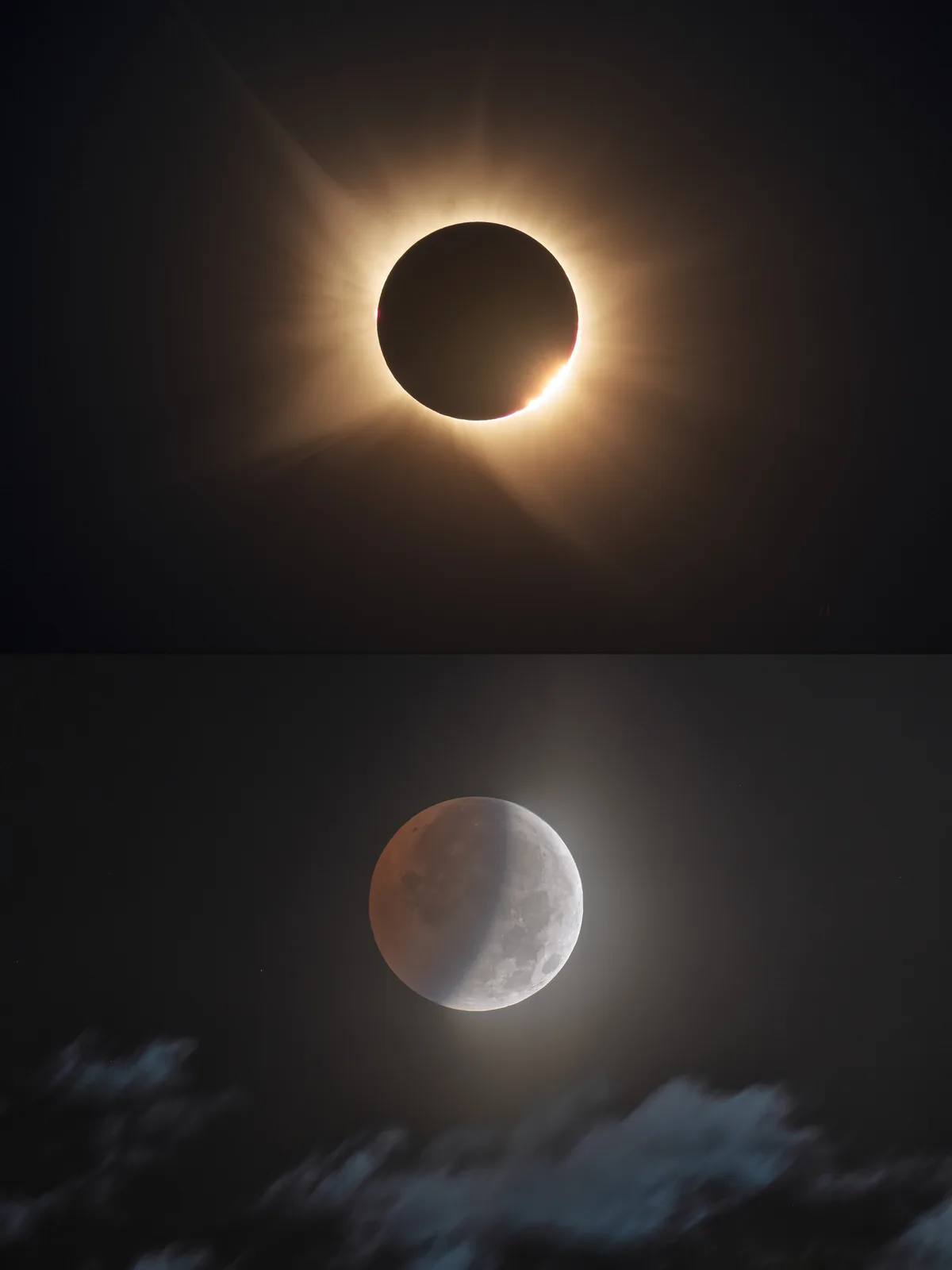
                                Eclipse Pair
                  Image Credit & Copyright: Gwenaël Blanck

   Explanation: Eclipses tend to come in pairs. Twice a year, during an
   eclipse season that lasts about 34 days, Sun, Moon, and Earth can
   nearly align. Then the new and full phases of the Moon, separated by
   just over 14 days, create a solar and a lunar eclipse. But only rarely
   is the alignment at both new moon and full moon during a single eclipse
   season close enough to produce a pair with both total solar and lunar
   eclipses. More often, partial eclipses are part of any eclipse season.
   But, the last eclipse season of 2026 did produce this
   fortnight-separated pairing of a total solar eclipse on August 12 (top)
   and an almost total lunar eclipse on the night of August 27/28. At New
   Moon, the solar eclipse was captured at Peñafiel, Spain near the
   begining of totality in this HDR composite image, revealing a flash of
   Bailey's beads and a golden solar corona. At the following Full Moon,
   the deep partial lunar eclipse was recorded from Sèvres, France. Also
   an HDR composite, the image shows this partial eclipse at closer to
   half its 93 percent maximum phase, so about half the visible lunar disk
   appears darkened and reddened within Earth's umbral shadow. The coming
   eclipse season will see an annular solar eclipse on 2027 February 6
   paired with a penumbral lunar eclipse on February 20/21.

              Growing Gallery: Lunar Eclipse of 2026 August 28
           APOD's main NASA site is moving: From apod.nasa.gov to
                            science.nasa.gov/apod
                     Tomorrow's picture: a grand design
     __________________________________________________________________

       Authors & editors: Robert Nemiroff (MTU) & Jerry Bonnell (UMCP)
            NASA Official: Amber Straughn Specific rights apply.
                  NASA Web Privacy, Accessibility, Notices;
                      A service of: ASD at NASA / GSFC,
                           NASA Science Activation
                             & Michigan Tech. U.
Recent days
 Sep 29Sh2-188: The Shrimp Nebula
 Sep 27Andromeda before Photoshop
 Sep 26Mirrored Meteor and Milky Way
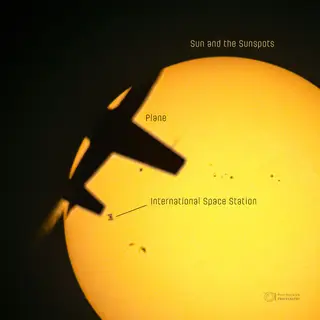 Sep 22Chance Triple Alignment: Plane, Space Station, Sun
 Sep 21Cocoon Nebula Wide Field
 Sep 20Analemma over the Callanish Stones
 Sep 19A Zodiacal Night
 Sep 18Messier 33: The Triangulum Galaxy
 Sep 17A Treasure Chest in the Carina Nebula
 Sep 16Webb's View of M64
 Sep 15A Daytime Eclipse: Moon Occults Venus
 Sep 14Where Your Elements Came From